Why build and own

Building is the future.

The best finance teams are becoming builders. With AI making building faster and more affordable, you no longer have to trade control for convenience.Teams are already building apps, models, and data architecture tailored to their own business with the help of agents. We lay the groundwork for you to do the same, sustainably.

Most finance teams have had two options. Now there's a third.
Spreadsheets
Flexible, but unscalable.
Familiar, with no new software costs. But manual work breaks and visibility drops as the company scales.
CPM software
Structure, at the cost of control.
Mature planning and governance. But every change needs the vendor or a consultant, and costs rise at every renewal.
An owned stack
Fits your business. Yours to change.
The freedom to build and flex with the governance of CPM software on familiar platforms, with your data and context owned by you.

Technology

Every layer of your stack, built to work together.

Agents are only as good as what's underneath them. See what each layer contributes, who the agents are, and how it all stays secure.

The five layers

Follow one question through the stack.

Each layer adds something the next one needs, from governed data to the context behind the numbers.

The question
“What GTM investments are paying off?”
Asked by a CFO, in the AI platform they already use
01
Data layer
Governed data from your key systems of record: one reliable source of truth for people and agents.
Integrations · Lakehouses and warehouses · Master data
In this example
Sourced from HubSpot, Salesforce, and NetSuite.
HubSpot
Salesforce
NetSuite
02
Semantic layer
Measures, hierarchies, and definitions that give your data one consistent meaning, so every report, model, and agent gives the same answer.
Data models · Measures and hierarchies · Row-level security
In this example
Defines MQLs, SQLs, channels, and territories, so marketing, sales, and finance count the same way.
03
Modeling layer
CPM-grade planning, forecasting, and reporting that add forward-looking data and scenarios informed by the business.
Planning and forecasting · Scenarios · Writeback · Connected Excel
In this example
Forecasts the funnel, bookings, and revenue.
04
Context layer
Everything that doesn't fit neatly in a database, captured and kept current so agents and decision-makers understand the why behind the numbers.
Context repositories · Documents, emails, and meetings · Curation workflows
In this example
Adds narratives from marketing, sales, and finance leadership, plus details from recent deal correspondence.
05
Agentic layer
Teams of agents that work alongside yours, on an open architecture you own, from MCP servers and orchestration to prompts.
Advisor · Analyst · Coach · Builder · Technician
In this example
Surfaces answers directly in your AI platform, with the ability to query governed data alongside connected context.
Advisor agent · in your AI platform
Illustrative answer
What GTM investments are paying off?

Partner-sourced pipeline is converting to bookings faster than any other channel this year. Paid social is driving MQL volume, but few of those leads reach SQL. Sales leadership's latest narrative credits the partner lift to the new co-sell motion, and recent deal correspondence points the same way.

Sources
Governed funnel data
Bookings forecast
Sales leadership narrative
Recent deal correspondence
+ Across every layer
AI adoption playbooks
Change management programs, training, and resources that drive consistent, effective adoption of AI, so your team keeps building after handoff. Yours to keep.
Change management programs
Training and workshops
Build standards and templates
Agent skills
Agent roles

A team of agents, each with a job.

Agents work alongside your finance team in the AI platform you choose, with access set by role. Every one runs on the same governed data and context.

Agent roles
What it does
Who uses it
Example ask
01
Advisor

Decision support and management reporting for the executive team, including building reports on request.

CFO and C-suite

“What drove the change in this quarter's forecast?”
02
Analyst

Function-specific analysis and modeling, such as GTM, operations, or data center analysis. The Advisor can call on it.

Functional leaders

“Which territories are behind on pipeline coverage?”
03
Coach

Guidance on business and technical context, so people learn the stack as they use it.

Finance team and end users

“How is contribution margin defined, and where does the data come from?”
04
Builder

Designs, builds, and tests new models, reports, and workflows.

Finance and operations power users

“Add a hiring delay driver to the headcount model and test it.”
05
Technician

Monitoring, troubleshooting, maintenance, and documentation. The Builder can call on it.

Finance team and end users

“Why didn't last night's data refresh complete?”
Architecture and security

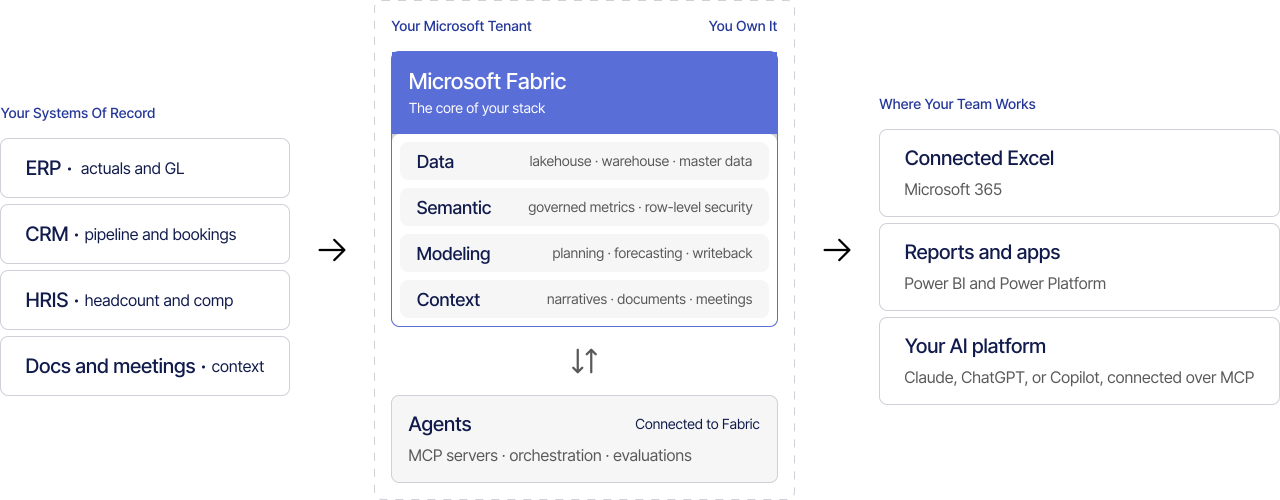
Inside your tenant, on Microsoft platforms.

Microsoft-native by design and AI platform-agnostic. Your data, context, and business logic stay in infrastructure you control, and AI platforms connect to them through governed access.
Data stays in your tenant
Your data, models, and context live in infrastructure you control, not in another vendor's copy.
Access set by role
Row-level security and role-based access carry through to every report, model, and agent.
Answers you can trace
Agents answer from queries on governed data and cite their sources.
Tested before release
Every agent is evaluated before it reaches a decision-maker, and monitored after go-live.
Governed by IT
Built on platforms IT already governs and pays for, with clear roles for finance and IT from day one.

Value

Maximize value from your AI investments.

Make performance management a competitive advantage with faster, better decisions, lower costs, and real AI leverage, all on a stack your team owns.

We measure every outcome, so the value is verified, not assumed.

Efficiency
60%+

time savings on manual effort
‍
Speed up your team and its information with fewer systems in play, cleaner data, and process automation.

Verified with
Time studies with a client on budget consolidation
Quality
B− → A+

on grading rubrics
‍
Raise quality instead of sacrificing it. Evaluations and rubrics help your team get better with every cycle.

Verified with
Grading rubrics on Fabric model builds
Trust
99%+

agent accuracy on an owned data and context layer, vs. roughly 50% on a frontier model alone
Deliver insights directly to decision-makers, with answers grounded in governed data and business context and traceable back to the source.

Verified with
Automated and manual evaluations, confirmed usage
Growth
Configure → Build

with AI
Your team doesn't just use AI. It learns to build with it, takes on new capabilities, and stays ahead of the curve.

Verified with
New team capabilities, expanded responsibilities
Cost
50–90%

lower software costs and control over AI usage costs
Consolidating data, modeling, and reporting into one platform streamlines software and administration costs. One client saved $1.2M a year by replacing its CPM software alone.

Verified with
Annual and monthly total cost of ownership savings
Ownership
100%

client-owned IP on infrastructure you control, with no OVG software in your stack
Keep leverage and optionality with full control of your stack, from the data to the agent prompts. Avoid lock-in and control your own destiny.

Verified at handoff
The full stack, AI adoption playbooks, and agent skills transfer to your team

Client stories

Proven across sectors and growth stages.

We've delivered for finance teams from $30M to $30B in annual revenue, across software, technology, manufacturing, energy, and capital markets. Every stack is shaped to the business, and we run OVG on the same tools and approach.

“A system we can continue to own and develop.”
Over the past two years, OVG has helped us move from a web of Excel-based financial forecast and reporting models to an integrated foundation based in Microsoft Fabric. Just as valuable, our finance team has greater flexibility to refine its models and answer new questions as the business scales rapidly. OVG has been a hardworking and thoughtful partner in building a system we can continue to own and develop.
Sean Dorsey
FP&A + Investor Relations Leader, Cerebras
“Owned by the business and tailored to our specific needs.”
OVG transformed our planning environment from a costly, centralized SaaS platform with lengthy enhancement cycles into a lightweight, flexible solution that is owned by the business and tailored to our specific needs. By integrating directly with our core data foundation, the platform has improved accessibility, accelerated decision-making, and enabled greater adoption of emerging technologies, including AI-driven capabilities.
SVP
Public enterprise client
“The autonomy the agentic layer gives our team.”
The most meaningful change has been the autonomy the agentic layer gives our team. We can build and iterate on far more sophisticated models without being constrained by the dataset limits of Excel or a planning platform's structure.
Carson Wood
FP&A Leader, ZoomInfo

Services

Pick a first use case.

Most engagements start with a fixed-scope APM pilot on one high-value use case, then expand as value is proven.

Definition
Agentic Performance Management (APM): planning, forecasting, reporting, and analysis on a stack you own, from data and models to context and agents, instead of dedicated CPM software.
Starter pilot
Financial reporting
Governed reporting on your actuals, with an executive reporting agent on top.
Proof

95%+ agent accuracy on executive reporting

Starter pilot
Budget consolidation
Departmental inputs consolidated in one governed model, with connected Excel.
Proof

100 workbooks consolidated in minutes · 60%+ time savings

Starter pilot
Revenue reconciliation
Bookings, billings, and revenue reconciled across CRM and ERP.
Proof

Open order reconciliation in seconds, on demand, not hours per month.

Starter pilot
Headcount planning
Driver-based headcount plans with writeback, tied to HRIS actuals.
Proof

Visibility and automation from hiring manager request to promotion.

Approach

Ownership shifts to your team as we build.

You own everything from day one. What shifts is who leads the build, until your team runs it on its own.

01 · 30–60 min
Conversation and demo
02 · 1–2 weeks
Use case selection
03 · Pilot
APM pilot
04 · Phased
Build, then co-build
05 · Hand over the keys
Handoff
06 · Optional
Managed services

OVG leads the build

Your team leads the build

Team

Your designer, architect, and builder.

We build your stack alongside your team and hand over the keys, so your decisions get faster and sharper every quarter, and you can keep building without us.

Performance management veterans
Our team has led finance and FP&A, built and sold CPM platforms, and delivered as consultants. We know what incumbent tools do well and where they break, and we design around both.
Anaplan · Adaptive · Oracle Hyperion
Builder-architects
We run OVG on the same stack, context layer, and agents we build for clients, and our team has built an agentic platform for building in CPM tools.
Finance meets engineering. The people who understand your forecast design the data model and the agents.
Independent advice
We don't sell software ourselves or rely on software vendor commissions. We operate in our clients' best interest.
Everything we deliver is yours, including the playbooks.
Caleb Maxson
Founder & CEO
Alvarez & Marsal · DocuSign · Anaplan · Sunrun
Joe Van Bolderen
Managing Director
Agentic AI exit · Grant Thornton · Spaulding Ridge
Jack Carter
Director
Sunrun · Finance + Rev Ops
Eric Tufte
Senior Manager
Amazon · Walmart · Finance + Data Science
Getting started

Start with a 30-minute conversation.

See a live demo, talk through your priorities, and pick a first use case to prove value.

What you'll see in the demo

01
A live executive reporting agent answering questions on governed data, with sources you can trace.
02
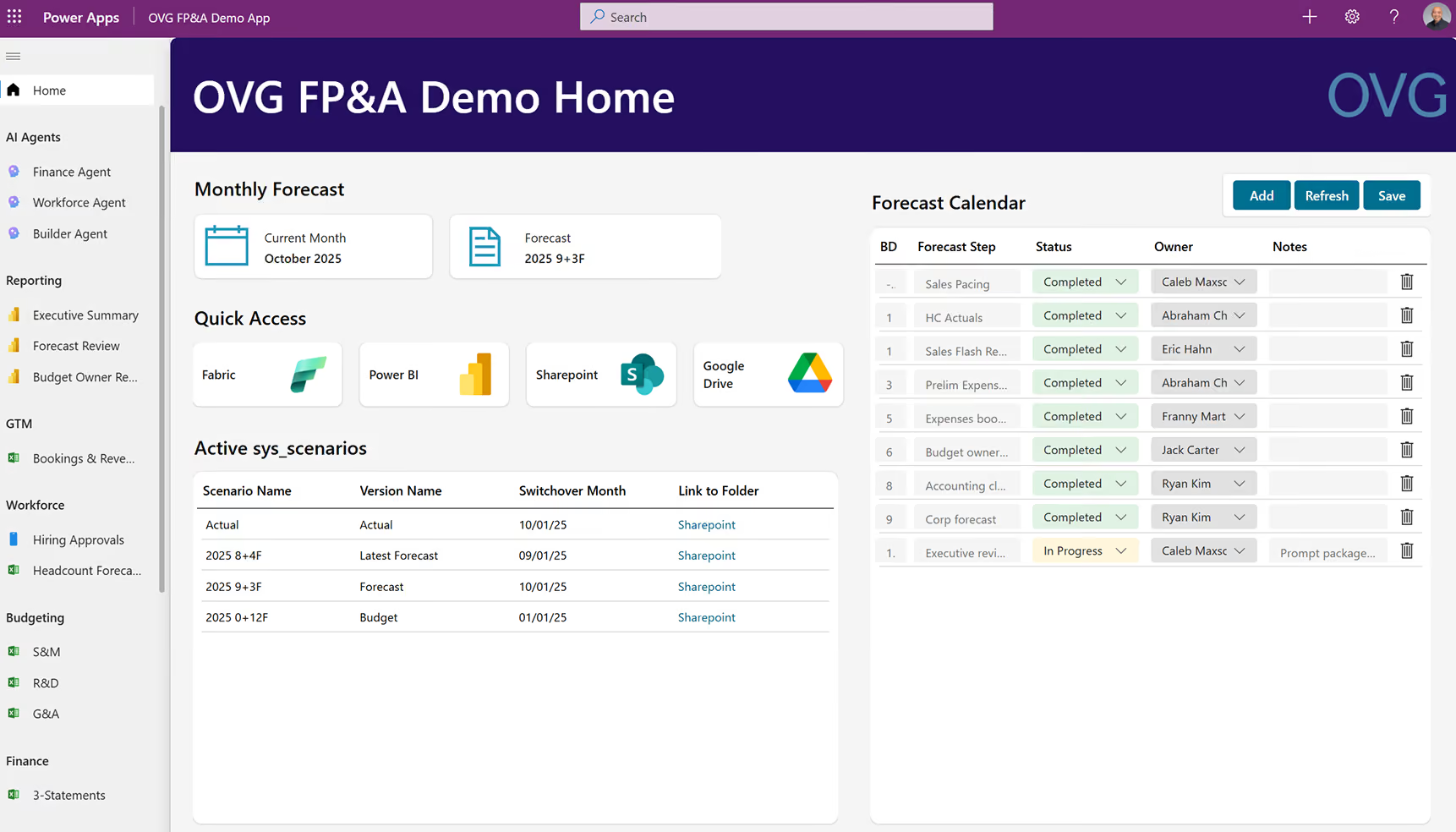
Planning and reporting in tools your team already knows: Power BI, Power Apps, and connected Excel.
03
How the context layer captures the why behind the numbers.
04
What your team owns at handoff, and how it keeps building.

We'll close by picking a first use case together.