Abacum: Powerful Enough to Scale, Simple Enough to Own

Every finance team is different — but the challenges tend to look the same: too many spreadsheets, too much back-and-forth, and planning tools that require an IT ticket just to make a simple change. Abacum was built to solve exactly that. Whether you're a lean FP&A team that needs to own your planning process end to end, a cross-functional organization that depends on tight collaboration between finance and the business, or a team stitching together data from a dozen different source systems, Abacum meets you where you are. With an intuitive interface that requires no IT involvement, 50+ self-serve integrations to the ERPs, CRMs, HRIS, and BI tools you already use, best-in-class collaboration features, and native scenario planning embedded directly within version control, Abacum gives finance teams the speed, flexibility, and confidence to plan smarter — without the complexity that usually comes with it.

OVG's Favorite Features of Abacum:

Built for Finance Teams, Not IT Departments
If your team has ever waited on an IT resource to update a report or connect a data source, you know how much that friction costs. Abacum was designed to be owned entirely by finance, with no IT involvement required. Its intuitive interface means your team can build, modify, and scale your planning environment independently, with new users ramping faster than on any other enterprise FP&A tool on the market.
Excel like syntax that is prompted and aided by the software to help you write.
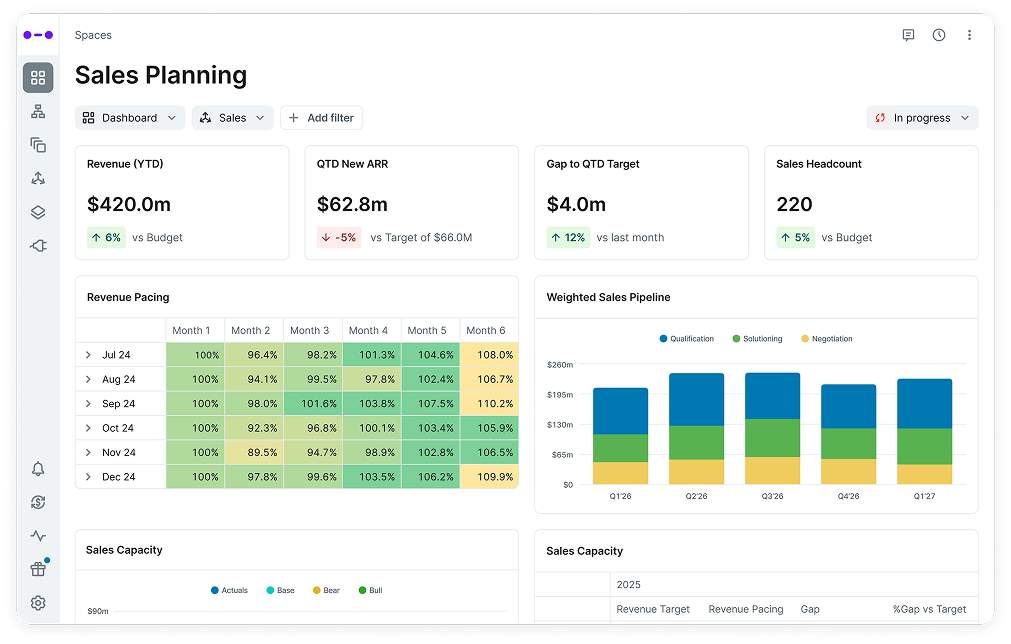
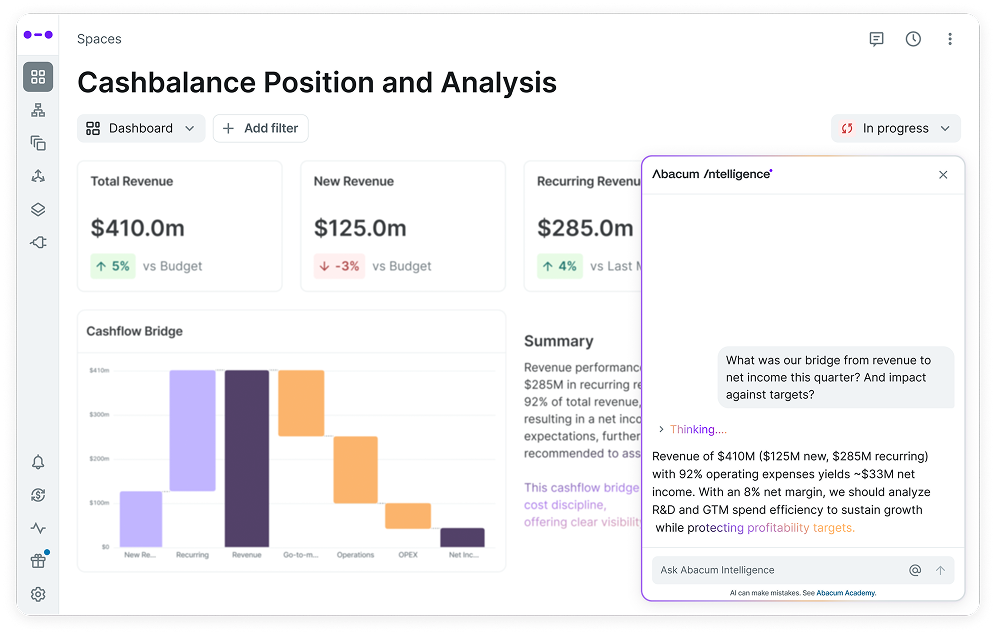
Space building (dashboards) is drag and drop with loads of customized formatting
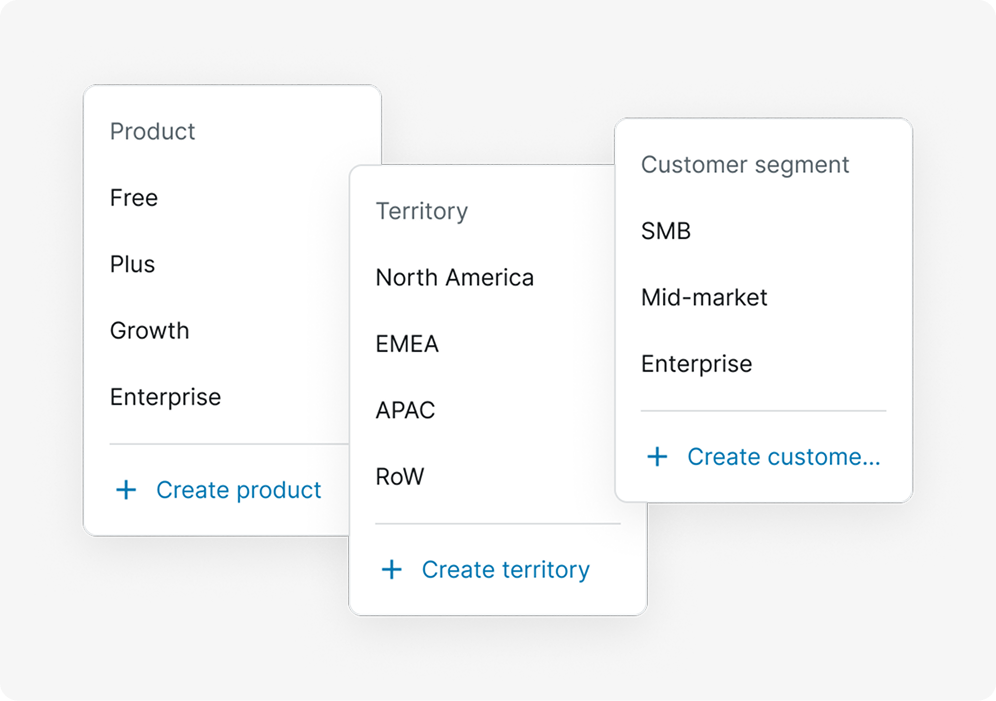
Creating dimensions can be done in just a couple clicks from source data
Reconciling headcount and new accounts are suggested for you, instead of searching for errors
Collaboration That Keeps Everyone on the Same Page
Modern FP&A doesn't happen in a silo. Finance teams are constantly coordinating with stakeholders who live outside of finance, and Abacum makes that seamless. With built-in workflows, commenting, task assignments, and shared views, Abacum brings everyone into the process — without overwhelming them.
Cell level commenting that is version specific with notifications via slack or email
Drill down into actual source data to identify drivers of variances
Add statuses, tasks, and approval workflows in spaces curated for content and security of specific end users
Mix context rich components into your spaces right beautiful and interactive charts and tables
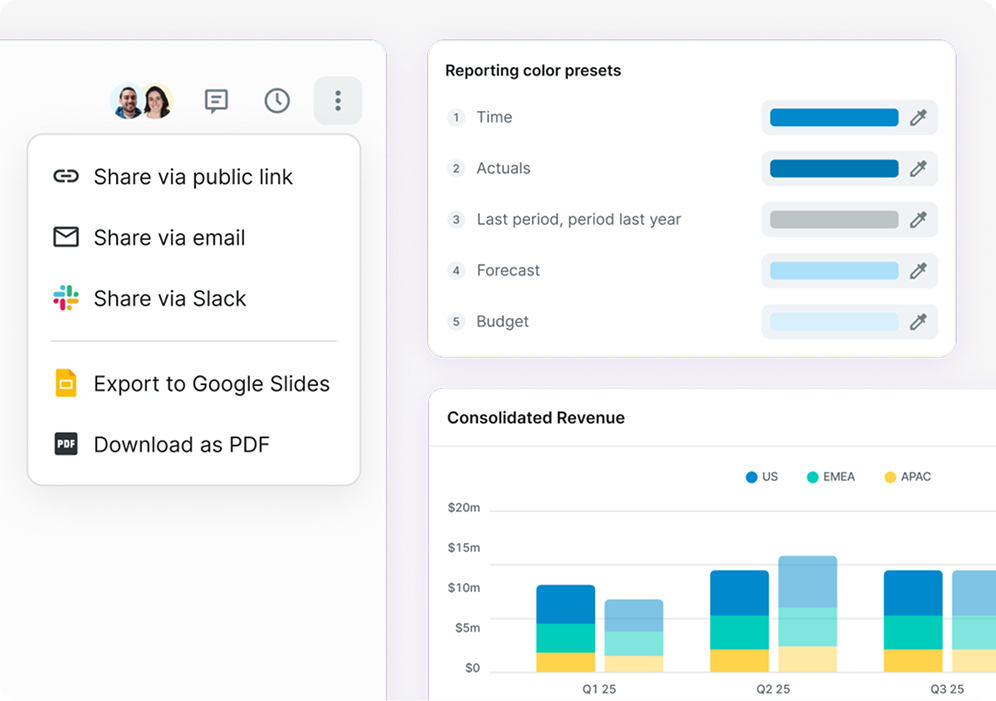
Generate pdfs of your spaces to avoid deck generation overload
Your Data, Connected — All in One Place
Chances are your financial data lives in more than one place. Abacum offers 50+ self-serve integrations with the ERPs, CRMs, HRIS, and BI tools your organization already relies on — think NetSuite, Salesforce, and Workday. Setup is fully managed by your finance team, so your models are always working off the most current numbers.
ERP - Netsuite, Sage, Rillet, Quickbooks and Campfire and more
CRM - Salesforce, Hubspot, Microsoft F&O and more
HRIS - ADP, Rippling, Gusto, Bamboo and more
Data Tools - Bigquery, Snowflake, SFTP Files, Amazon S3 and more
Scenario Planning and Version Control, Done Right
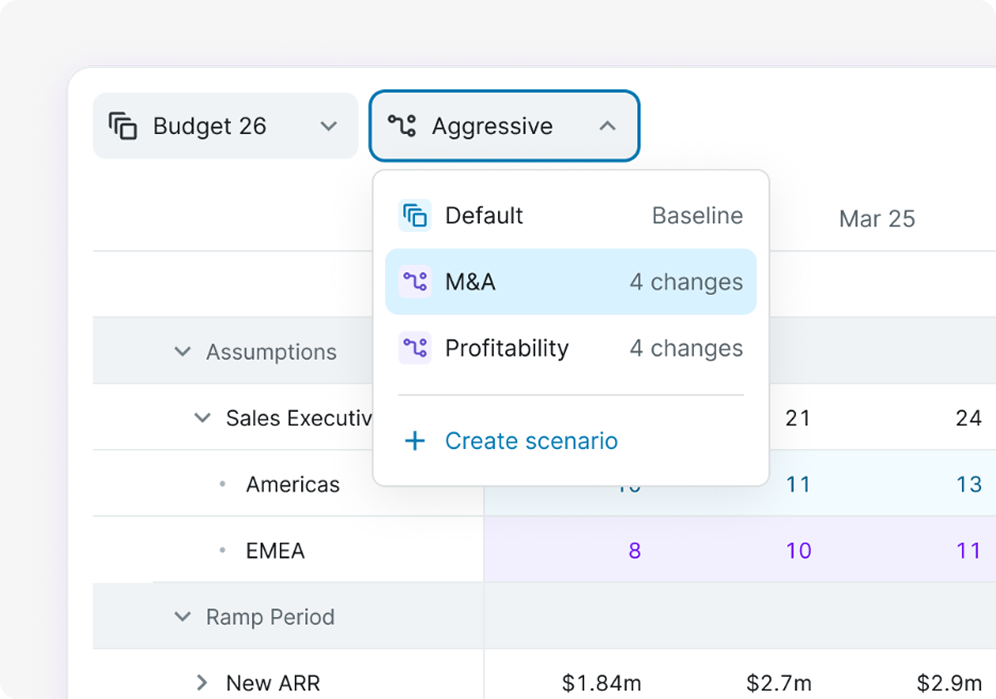
Scenario planning is at the heart of good FP&A, and Abacum makes it easier than ever to manage. Unlike tools that treat versions and scenarios as an afterthought, Abacum embeds native scenarios directly within each version of your model — giving you a clean, structured way to compare outcomes without duplicating work or losing track of assumptions.
As many versions as you'd like with simple settings for copying, locking, and adjusting switchover months.
Layer a multitude of scenarios within those versions to adjust for range of outcomes
Easy to use modeling interface for differentiating logic for actual periods vs forecast periods

Abacum's Use Cases

Revenue Planning
Abacumis an AI-native FP&A platform built for revenue planning, helping finance,RevOps, and FP&A teams move from spreadsheets to structured, data-driven models. It supports top-line growth through forecasting, scenario planning, and modeling tools.
Key benefits
Revenue forecasting:Real-time tracking with both top-down and bottom-up planning.
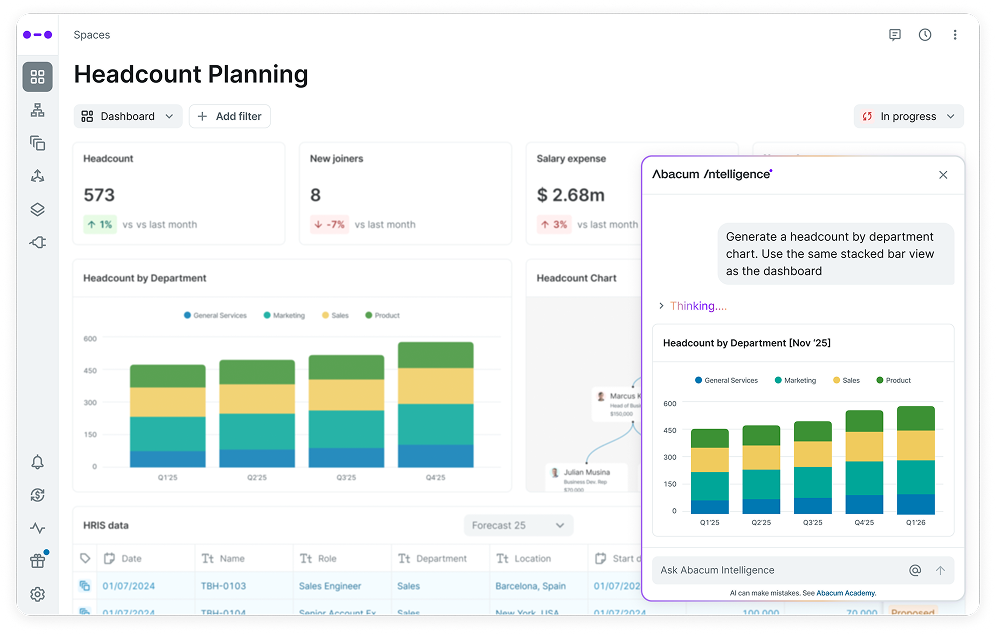
AI-assisted modeling:Build custom models quickly with smart formulas and autocomplete.
Scenario testing:Explore “what-if” cases to assess risks and sensitivities.
Centralized planning:Combine revenue, quota, and capacity planning in one place.
Features:
Revenue forecasting
Sales capacity planning
Cohort analysis
Sales quota planning
Headcount Planning
Abacumpresents itself as an AI-native FP&A platform designed for headcount planning, helping finance, HR and department leaders move from isolated spreadsheets to a unified, strategic workforce-planning process. The tool supports aligning staffing and budget decisions with business outcomes.
Key benefits
Align headcount to strategy: Create workforce plans that tie hires, open roles, and costs to business goals.
Plan and manage all workforce changes: Set budgets, forecast hires, track open requisitions, and reconcile actualsinone platform.
Centralisedapprovals and workflows: Streamlines the approval process for role-changes or new hires, reducing time and effort.
Features:
Workforce budgeting
Role forecasting
Open-role reconciliation
Approval workflows for staffing changes
Scenario planning
Abacum’sscenario-planning feature lets finance and FP&A teams build multiple “what-if” versions of their plans (base, bull, bear), adjust key assumptions, and instantly see the downstream impacts across revenue, costs, hiring, etc.
Key benefits
Quick scenario generation: Create linked scenario versions from an existing model with one click.
Dynamic updates: Changes to one driverautomatically updateall connected formulas and forecasts.
Side-by-side comparison: Easily view multiple scenarios at once to compare impacts and inform decision-making.
Features:
Testing alternative growth, cost, or workforce plans
Stress-testing business models under different market conditions
Preparing board-ready projections across multiple outcomes
Investor reporting
Abacum’sinvestor-reporting module helps finance teams build board- and investor-ready reports by automating data consolidation, enabling real-time metrics visibility, and enabling formatted dashboards tailored to stakeholder needs.
Key benefits
Real-time metrics for investors/board: Access up-to-date financial and operational data without manual refreshes.
Custom dashboards & formatting: Create reports aligned with investor expectations, with flexibility in design and exportability for board books or memos.
Automation of manual workflows: Reduce reliance on spreadsheets and versions by automating consolidation and report generation.
Features:
Preparing board-books and investor updates
Providing dashboards and real-time views to external stakeholders
Streamlining data consolidation across systems for external reporting
P&L, Balance Sheet, Cash Flow
Abacum’smodule for P&L, Balance Sheet & Cash Flow (BS & CF) enables finance teams toconsolidate, model and report all three key financial statements in a single platform.
Key benefits
Unified consolidation: Combine data across multiple entities and currencies; automate FX adjustments to simplify multi-entity/month-end consolidation.
Real-time visibility: Get live access to P&L, BS and CF statements, with drill-down and variance analysis.
Enhanced month-end cycle: Shorten reporting time and increase accuracy by removing fragmented spreadsheets and manual FX entries.
Features:
Multi-entity financial consolidation
Automating month-end statement production
Real-time financial performance monitoring across statements
Drill-down analysis of profit, assets/liabilities, and cash flows
Roll Ups
The Roll-Ups & Consolidations module enables companies with multiple entities to roll up financialsefficiently—bringingtogether disparate data sources,currenciesand business units into unified dashboards.
Key benefits
Native multi-entity logic: Supports roll-ups using a dimension-based model without heavy technical setup.
Flexible ERP integrations: Can pull in and reconcile data from multiple ERP systems for firms with different accounting tools.
Real-time dashboards & scenario planning at roll-up level: Enables live consolidation views and what-if analyses across entities.
Features:
Consolidatingfinancials across multiple entities or geographies
Multi-entity reporting with foreign-currency normalization
Creating centralized dashboards for business units and parent company
Enabling access controls and versioning acrossconsolidatedmodels