Managing the TCO of AI Adoption

What if I told you that you could save 1,000x-10,000x on AI costs?
Read on for how we are balancing the TCO of AI for Finance teams.
AI costs are all over the headlines nowadays, and it's almost certainly going to get murkier before it gets better. A lot of budgets are going to get blown up by variable AI costs over the next couple of years.
The demand and the potential are real, but the real cost of AI capacity is still being worked out. See Anthropic's recent deals with Google and SpaceX, and Google's record-breaking $85B equity raise for AI infrastructure (with more debt to come?).
Total cost of ownership is top of mind for us in this AI transition, especially after seeing the pain of vendor lock-in with specialized EPM tools.
One of our clients saved more than $1M annually on their EPM platform by switching to Fabric. They were using less than 3% of the compute the vendor allocated to them, despite broad adoption across hundreds of users. They stand to save even more by transitioning off their specialized ETL tool.
So how do we avoid the same costly missteps with AI adoption, lower TCO, and actually realize value?
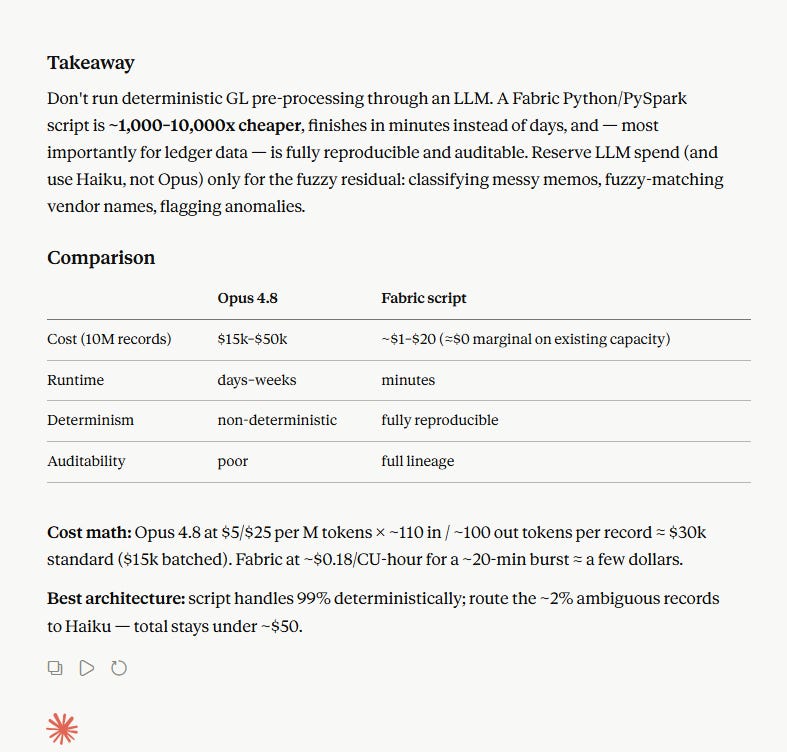
Build with AI, don't just consume it. This is the difference between AI as capex and AI as opex. First using AI to build the data architecture and ETL pipelines that pre-process your 10M transaction general ledger and then using AI to query and analyze it costs a fraction of dropping that GL into Excel and having Opus 4.8 brute force it every time.
See below for Claude's analysis: 1,000x-10,000x in cost savings at current prices!
Stay model-agnostic. It feels like every month there's a new development, with models leapfrogging each other on different fronts. For Finance teams doing everything from coding to presentations, an approach that lets you plug and play models and segment usage provides critical optionality in the near term. One big trend is the move toward cheaper models (Microsoft appears to be heading this way with their MAI models). FP&A teams don't need the same models that researchers use for fluid dynamics or that engineers use to review massive codebases.
Focus on adoption, not tokens. Our measure of success, both internally and with clients, isn't how many tokens we use. It's how many people actively use what we build. A skill one person uses every day? Not bad. A skill 10 people use every day? Great. A skill an executive uses every day? Extreme value. That last one is what we prioritize, so we avoid repeating what happened with Power BI and Tableau: a thousand reports that may collectively answer every question but ultimately never get used.
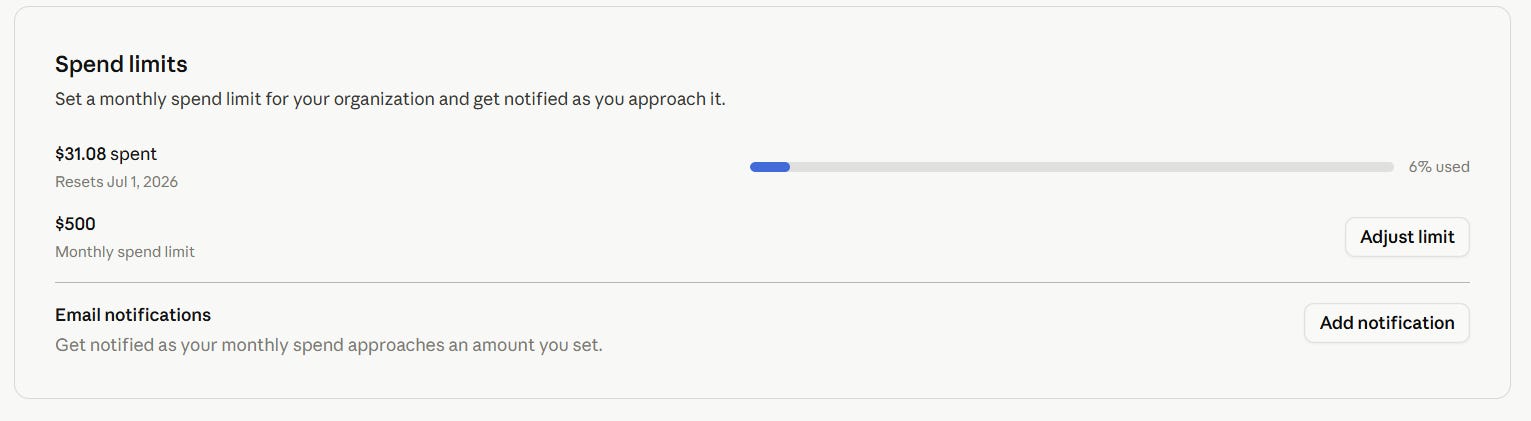
Our latest month of Anthropic platform spend is below. It's growing, but not exponentially. Our Fabric capacity is growing alongside it, and so is our team.