Owning vs. Renting Your Performance Management Stack

CEOs and CFOs must weigh third-party risk carefully when choosing their performance management tech stack in the AI era.
We see too many companies unable to leverage AI well because they're locked into legacy vendors that were best-in-class right up until ChatGPT dropped.
Now they're trapped with escalating recurring costs, heavy switching costs and risks, and a dependence on the success of their vendor's AI strategy rather than their own.
The recent standoff between Anthropic and the US government highlights this exact issue. Regardless of underlying motivation, the customer finds they don't have full control over their own destiny with a supplier.
The supplier's top model is subsequently abruptly pulled from production, showing other customers that they also do not have control over their destiny!
Decision-makers can't afford to be left in the dark, especially as collateral damage. My first tests of Fable showed impressive results, but they were entirely different from Opus, which I had tuned to my preferences. Had I been more dependent on Fable, this would have been a disaster.
There will be significant lock-in risks with models and AI platforms. Some may be worth taking. But those risks shouldn't be unnecessarily multiplied down the stack.
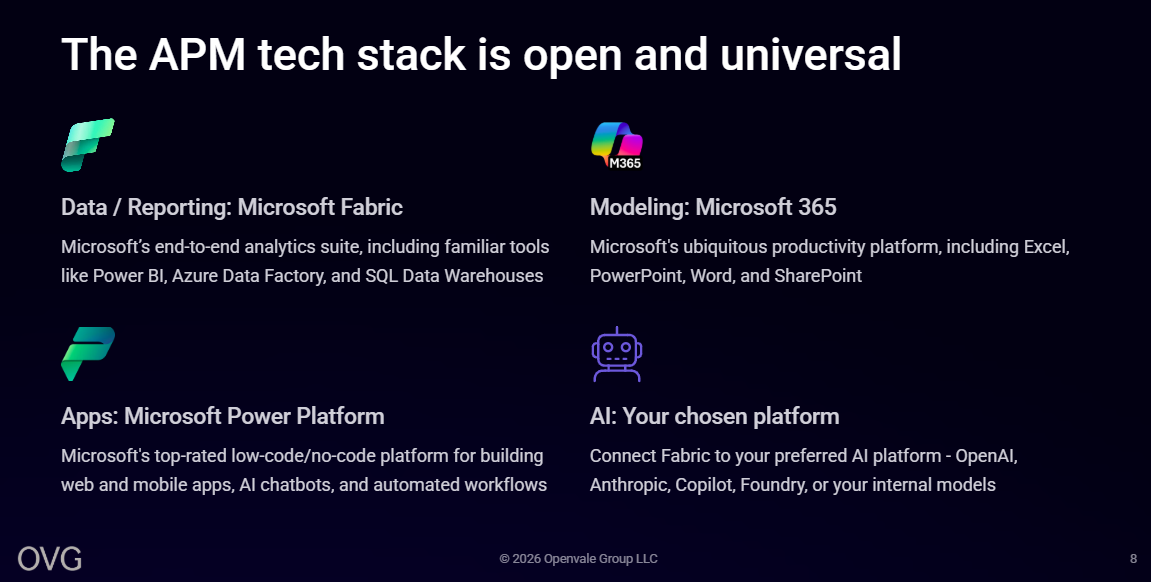
That's why we prioritize first-party ownership in our Agentic Performance Management tech stack.
It's built on open, interoperable platforms like Fabric, Excel, and Power Platform that live entirely on the client side, all written in universal languages: SQL, Python, JavaScript.
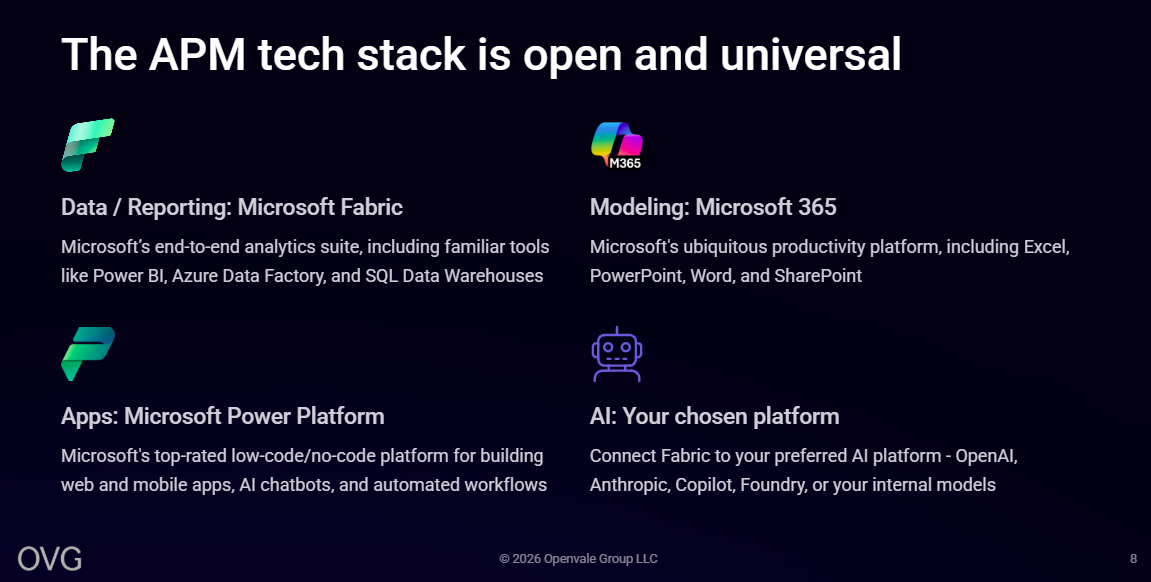
They work better together, but if a new player emerges, you can download your entire workspace as a zip file any time you want, and agentic coding will rebuild them faster than ever.
We're working to extend the same mindset to the agentic layer, making capabilities portable across the major AI platforms and models, or even your own interface (which some pioneering clients are already doing with success).
We also expect other open-source and other models to play more of a role going forward. Agents can be to be portable by relying more on the prompts, skills, and tools than the model itself. These agents also happen to be far more cost-efficient.
In a world of subscriptions where everyone rents for convenience, our belief at OVG is that first-party ownership of performance management is what will separate the leaders from the rest of the pack.